PRESBYOND® LASER EYE SURGERY IN SYDNEY
Near Vision Clarity: Laser and Lens Based Options
Improve your vision and live life on your own terms
What do you need help with?
Laser Blended Vision, PRESBYOND®

Are you tired of reading glasses? Learn about laser blended vision, PRESBYOND®
Are you tired of constantly reaching for your reading glasses every time you want to see something up close? You are one of millions of Australians who have presbyopia, the natural loss of near vision that comes with age, typically from around 40 years old. With PRESBYOND LASER EYE SURGERY, you can regain your youthful vision and reduce or even eliminate the need for reading glasses.
Blended vision correction improves near and distance focus by reshaping the cornea using a laser-based approach. Eagle Eye Surgeons are the first clinic offering this non-invasive eye surgery in Sydney.
Understanding presbyopia and the need for reading glasses
Presbyopia is a common eye condition that affects everyone as we age. It occurs because the lens of the eye loses its flexibility, making it difficult to focus on close-up objects. As a result, people find themselves relying on reading glasses to perform tasks such as reading, using electronic devices, or doing intricate work.
The need for reading glasses can be frustrating and inconvenient. They are easily misplaced and many people need multiple sets of glasses. For people with a busy and active lifestyle, reading glasses can be a hassle, especially when engaging in physical activities or when the glasses get in the way of other eyewear, such as sunglasses.
Introducing PRESBYOND®: A customised near vision improvement solution
PRESBYOND® offers a modern treatment alternative to reading glasses for people struggling with presbyopia. This innovative treatment utilizes advanced laser technology to reshape the cornea, allowing for improved near vision and eliminating the need for reading glasses in the majority of cases. The procedure is quick, painless, and highly effective, providing patients with increased clarity and focus when reading, using electronic devices, or performing close-up tasks.
How does PRESBYOND® work?
PRESBYOND® is a LASIK based procedure. A small flap is raised with precision using a laser. The corneal surface is then reshaped using a separate laser, and the flap is replaced. The reshaping process allows the eye to focus light properly, resulting in improved near vision without the need for reading glasses. The entire procedure is performed under local anesthesia, ensuring that patients remain comfortable throughout the process.
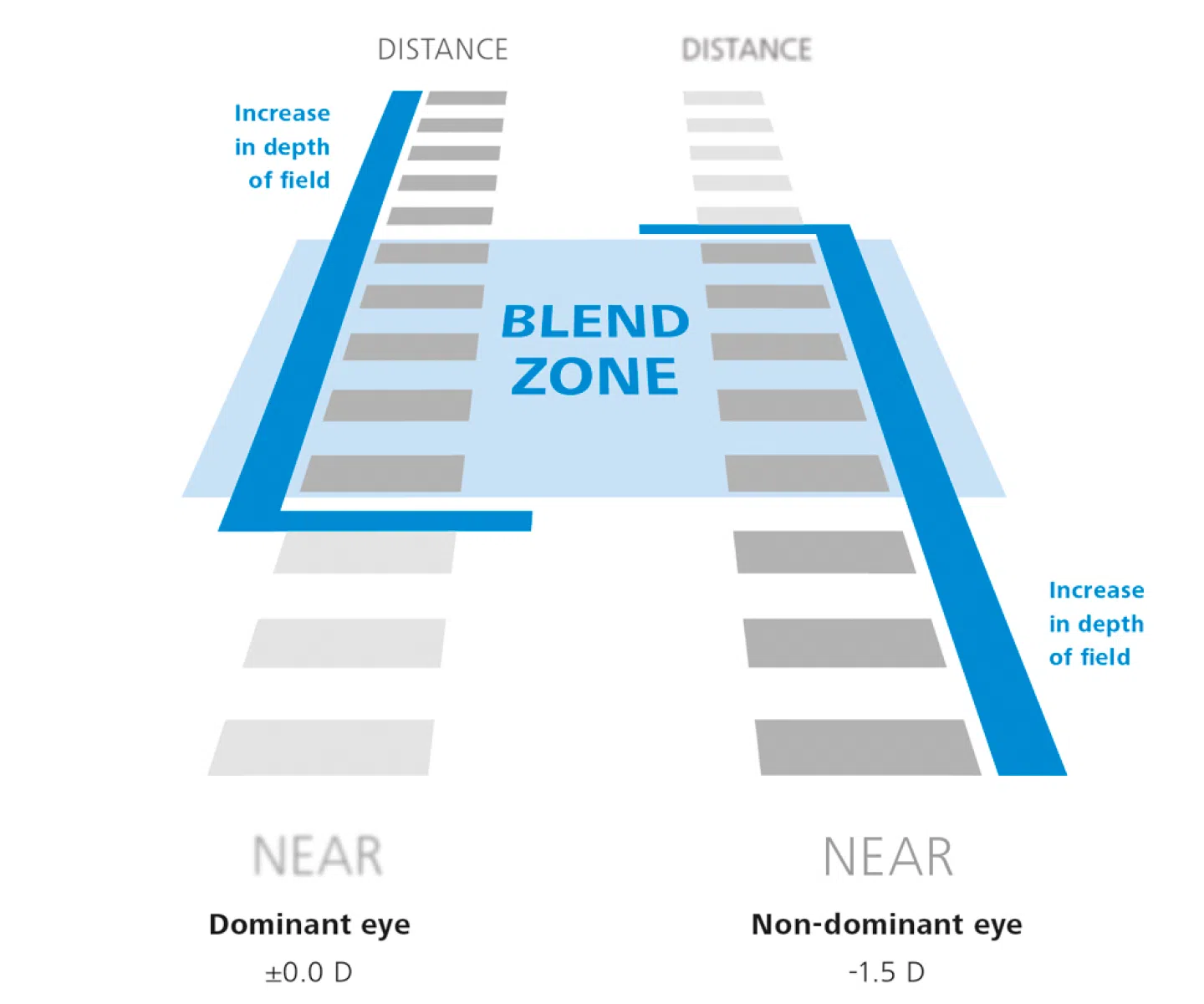
The non-dominant eye is corrected to near vision, and the dominant eye is corrected for distance. This is similar to a traditional treatment called monovision. The difference is that PRESBYOND® incorporates an additional blended zone of vision into each eye, to improve the ability of the brain to adjust to the new visual balance. The result is that PRESBYOND® laser blended vision is tolerated by almost all patients (97%) [1], compared with monovision techniques which are tolerated by 59-67% of patients. [2]
PRESBYOND® laser blended vision technique:
- Corrects naturally occurring spherical aberrations of each eye.
- Incorporates preoperative wave-front data to fine-tune the depth of field for each eye.
- Generates a bespoke nomogram that records your eye parameters and optimizes target refraction.
- Pupil size can also be accounted for by altering the optical zone size of treatment.
- Reshapes the cornea to provide clear near, far and intermediate vision.
- The monovision component can be pre-adjusted for the patient’s tolerance level.
[1] Reinstein DZ, Archer TJ, Gobbe M. LASIK for Myopic Astigmatism and Presbyopia Using Non-Linear Aspheric Micro-Monovision with the Carl Zeiss Meditec MEL 80 Platform. J Refract Surg. 2011 Jan;27(1):23-37.
[2] Evans BJ. Monovision: a review. Ophthalmic Physiol Opt. 2007 Sep;27(5):417-39.
What does the data show?
PRESBYOND® research has recently included the study of a group of commercial and military pilots requiring aeromedical certification who underwent the treatment, published in the Journal of Refractive Surgery in 2023. Pilots are a unique professional group for whom excellent vision is critical. Binocular distance and near vision are both important for their work. All pilots treated with PRESBYOND® achieved 20/20 vision for distance at 12 months. Of these, 78% also achieved the near vision equivalent of 20/20 (J1). [1] Of the pilots who did not achieve J1 vision, 100% had J2 vision. This is good enough to read size 4 font, the equivalent of small-print legal disclaimers on a bank statement. [2]
[1] Reinstein DZ, Ivory E, Chorley A, Archer TJ, Vida RS, Gupta R, Lewis T, Carp GI, Fonseca A, Parbhoo M. PRESBYOND Laser Blended Vision LASIK in Commercial and Military Pilots Requiring Class 1 Medical Certification. J Refract Surg. 2023 Jan;39(1):6-14.
[2] McDonald MB, Barnett M, Gaddie IB, Karpecki P, Mah F, Nichols KK, Trattler WB. Classification of Presbyopia by Severity. Ophthalmol Ther. 2022 Feb;11(1):1-11.

Who is the ideal candidate for PRESBYOND®?
People between 40 and 60 years old who need reading glasses are typically good candidates for PRESBYOND® laser blended vision. This age group has typically been treated with clear lens extraction for refractive vision correction which carries a small but real risk of retinal detachment or rarely severe infection in the eye. Because we are not operating within the eye, only on the surface, PRESBYOND® is a safer procedure. The refractive correction created can also be adjusted in the occasional instances when the blended vision is not well tolerated.
The non-linear presbyopic ablation profile and the induction of natural spherical aberrations of the cornea, thereby increasing the depth of field, created by PRESBYOND®, has lasting effects. Even when a future cataract forms individuals will retain the PRESBYOND® ablation profile after treatment. A simple monofocal intraocular lens can be implanted without loss of the benefit of laser blended vision for reading.

Is PRESBYOND® right for you? Assessing candidacy and eligibility.
We offer a free laser assessment to determine whether you are suited for laser blended vision. Our team will evaluate your eyes and perform a range of scans and tests to determine whether you are a candidate for laser eye surgery, and recommend the bespoke approach for you.

Book a complimentary laser assessment now
HOW IT WORKS
The PRESBYOND® procedure: What to expect before, during, and after
Before the PRESBYOND® procedure
Before the procedure, you will undergo a comprehensive eye examination to assess your current vision and overall eye health. This examination will include measurements of the cornea and a discussion of the goals and expectations of treatment.
On the day of the procedure
On the day of procedure you will be given a local anesthetic to ensure comfort throughout the process. The eye will be kept open using a speculum device to prevent blinking and allow the laser to work effectively.
During the procedure
The laser will create a small flap in the cornea, followed by the reshaping of the underlying tissue. The entire process typically takes only a few minutes per eye, and most people experience minimal discomfort.
After the procedure
After the procedure you may have some mild eye discomfort or a foreign body sensation. This is normal and we will prescribe eye drops to manage these temporary symptoms. It is important to follow all post-operative instructions provided by the eye care professional to ensure proper healing and optimal results.
Recovery
Laser blended vision will give you glasses free vision for distance and reading. The time taken to adjust varies from person to person, but most people are able to return to normal activities glasses-free 24 to 48 hours after the procedure. It may take a few months to fully adjust to your new laser blended vision. At the one year mark 97% of patient have fully neuro-adapted. Our comprehensive preoperative testing ensures that you are a good candidate for the procedure.
PRESBYOND® Risks
Presbyond is a very safe and well tolerated procedure. Risks are largely the same as those for all laser eye surgery.

Dry Eyes
Temporary dryness is common after laser eye surgery, but it typically resolves within a few weeks as the eyes adjust. Preservative free lubricating eye drops may be recommended to alleviate discomfort. Our surgeons are experts at helping to manage dry eyes during this period.

Glare and Halos
Likely Outcome: Some patients may experience glare or halos, especially at night, in the initial postoperative period. This is often temporary and tends to diminish as the eyes continue to heal.

Overcorrection or Undercorrection
Likely Outcome: While advancements in technology minimize the risk, there’s a slight chance (1-5%) of overcorrection or undercorrection. Further adjustments can be made if necessary, free of charge for up to 2 years following the initial procedure.

Visual Disturbances
Likely Outcome: Patients may experience minor visual disturbances initially, such as fluctuations in vision. These usually subside during the healing process.

Adaptation Period
Likely Outcome: Adapting to PRESBYOND® may take some time. Individuals often experience progressive improvement in vision over several weeks. The time to fully ‘neuroadapt’ is variable but often up to several months. Patience during this period is important.

Intolerance to PRESBYOND®
Likely Outcome: The vast majority of people adapt well however it may be necessary to perform an enhancement (6-10% of people) to ensure the best possible outcome.
It is unusual to have to convert the PRESBYOND® treatment to traditional distance correction. As the lens has not been disturbed and there has been nothing inserted into the eye, this can be achieved with the same laser surgical technique as the PRESBYOND® treatment, LASIK. This ensures that patients achieve a visual outcome that aligns with their comfort and expectations. In this sense, the procedure is completely reversible.
Comparing PRESBYOND® with other near vision correction options
- PRESBYOND® is just one of several options available for near vision correction.
- Other non-surgical options include traditional reading glasses, bifocals, and monovision contact lenses.
- Intraocular lens surgery is also an option for treating presbyopia. Our surgeons may discuss this with you if they feel it is a better option. If you have a cataract, you are no longer a candidate for laser vision correction.
- Another advantage of PRESBYOND® is that it provides a precise and personalised solution compared to multifocal contact lenses or monovision, which may not be suitable for everyone.
- The laser technology used in PRESBYOND® allows for customised corneal reshaping, ensuring bespoke, optimal results tailored to each individual’s needs.
Frequently Asked Questions about PRESBYOND®
No, the procedure is performed under local anesthesia, ensuring that patients remain comfortable throughout. Some patients may experience mild discomfort or foreign body sensation after the procedure, but this can be managed with prescribed eye drops.
The entire process typically takes only a few minutes per eye. However, you should expect to spend a few hours at the clinic for pre-operative preparations and post-operative instructions.
Yes, the corneal changes performed in PRESBYOND® are permanent. Occasionally there is some residual refractive error, or vision can regress over time. If this occurs it is simple to do a re-treatment, which our surgeons will perform free of charge in the first 2 years after initial laser treatment. If the PRESBYOND® treatment is not tolerated and symptoms of cross-blur persist despite touchups and temporary glasses correction, PRESBYOND® can be reversed to traditional distance correction. In this sense, the visual results of PRESBYOND® are completely reversible.
PRESBYOND® uses the same technique as LASIK to correct your eyes but creates a non-linear presbyopic ablation profile. Unlike conventional laser eye surgery, which primarily focuses on correcting nearsightedness, farsightedness, and astigmatism, PRESBYOND® is designed to address presbyopia, a condition that affects individuals over the age of 40 and causes difficulty in focusing on close objects. It also addresses the other optical abnormalities, aiming to allow patients to be free of both reading and distance glasses. The specialised excimer laser, MEL 90, induces natural spherical aberrations on the cornea, in turn, increasing the Depth of Field.
PRESBYOND® has a key advantage over traditional monovision. It is proven to be tolerated by more patients (97%) as opposed to 59-67% for conventional monovision. Both techniques have one eye treated for near and one eye for distance vision, but PRESBYOND® is a more sophisticated and nuanced procedure which creates a range of blend zones within both eyes. This allows the eye to focus on both near and distance objects and gives a greater intermediate range of focal zones. It offers a more continuous range of vision, reducing the need for reading glasses or bifocals. This procedure is suitable for individuals who want to regain their near vision without compromising their distance vision.
As with any surgical procedure, there are potential risks and complications associated with PRESBYOND®. These may include dry eyes, glare, halos, rarely infection or flap related complications.
PRESBYOND® has a learning curve that lasts a variable amount of time, as the brain adjusts to the blended vision. This is often a few months. A small minority of people may not be able to adjust well to the blended vision at the one year mark (3% of patients), in which case it can easily be converted to a traditional distance correction. Generally though, it can be improved with a laser touchup (6-10% of patients). This is much simpler to adjust than with lens based presbyopia corrections.
PRESBYOND® typically is better tolerated and has a shorter adjustment period than monovision.
Whilst for the majority of people reading glasses are no longer required, there will be a small number who may find that for very small newspaper prints they still require some increased magnification in the form of reading glasses.
Don’t let presbyopia hold you back from enjoying life to the fullest. With PRESBYOND®, you can say goodbye to the frustration of constantly searching for your misplaced reading glasses or struggling to decipher small print. This treatment offers a long-lasting and reliable alternative to traditional reading glasses. If you’re tired of the hassle and inconvenience of reading glasses, book a free laser consult with Eagle Eye Surgeons to determine your eligibility and take the first step towards a life without glasses, both for reading and distance.

Take our laser suitability quiz now
Lens Based Surgery
Unlocking Clarity: Exploring the Benefits of Lens Based Refractive Surgery
Lens-based refractive surgeries are an alternative to laser surgeries for vision correction, and may be a more suitable option in some cases. These procedures work by either placing a lens into the eye in front of the native lens, or replacing the natural lens of the eye, to correct refractive errors and improve vision. At Eagle Eye Surgeons, we offer several different types of lens procedures, depending on the requirements of our patients.
Clear Lens Extraction (CLE)
Clear lens extraction (CLE), also known as refractive lens exchange, is a lens-based refractive surgery which involves removing the natural lens and replacing it with an artificial intraocular lens (IOL), customized to the patient’s specific vision needs. This procedure not only corrects refractive errors but can also address age-related vision issues such as presbyopia. We offer this surgery to patients 50 years and over, in the absence of cataract.

Addresses Age-Related Vision Issues
Clear lens extraction can also be used to treat presbyopia, the need for reading glasses in middle age. We can also treat this with our laser blended vision (PRESBYOND®) laser technique, however, in some patients our surgeons may recommend lens surgery as the more suitable option. A common reason for this is if there is evidence of early cataract formation, as replacing the ocular lens also preemptively treats the cataract.

Suitable for a Wide Range of Refractive Errors
Unlike laser eye surgery, which is limited in its ability to correct certain refractive errors, non-laser refractive surgery options such as phakic IOLs and clear lens exchange can address a broader range of vision issues. Whether you have severe nearsightedness, farsightedness, astigmatism, or age-related vision problems we can provide a solution tailored to your specific needs.

Long-Term Solution
Lens based surgery in the form of clear lens exchange means that future cataract surgery is no longer required, reducing the need for additional procedures in the future.

Preserves Corneal Thickness and Integrity
Lens based surgeries work by modifying or replacing the lens, leaving the cornea untouched. Laser surgery involves modifying the contour and thickness of the cornea. This means in patients with thinner corneas, lens based surgeries may be a better option.

Risks and Considerations of Lens based Refractive Surgery
As with any surgical procedure, lens based refractive surgeries carry certain risks and considerations that should be carefully weighed before making a decision. While these procedures are generally safe and effective, it’s important to be aware of potential complications. Our patients will be provided with an in depth description of potential complications in our ‘Custom Lens Based Refractive Procedures’ booklet.
HOW IT WORKS
The Process of Lens Based Refractive Surgery

1. Preoperative Evaluation
Before undergoing lens based refractive surgery, you will need to undergo a comprehensive preoperative evaluation. This evaluation typically includes a thorough eye examination, measurement of your refractive error, assessment of your corneal thickness, and evaluation of your overall eye health. Based on these findings, your surgeon will determine if you are a suitable candidate for the procedure.

2. Surgical Planning
Once you have been deemed a suitable candidate, your surgeon will work with you to develop a surgical plan tailored to your specific visual needs. This includes selecting the type of lens based surgery that is most appropriate for you, as well as determining the power and type of intraocular lens to be implanted if applicable.

3. Surgery Day
On the day of the surgery, you will typically be given local anesthesia to numb the eye and ensure your comfort. The surgical procedure will be performed in our selected operating theaters and will vary depending on the specific type of lens based refractive surgery you are undergoing. Your surgeon will guide you through each step of the process and ensure that you are well-informed and comfortable throughout the surgery.

4. Post-operative Care
Following the surgery, you will be given specific instructions for post-operative care. This will include the use of prescribed eye drops, instructions for avoidance of strenuous activities in the early postoperative period, and regular follow-up visits with your surgeon. It’s important to adhere to these instructions to ensure proper healing and optimal visual outcomes.

5. Laser Touch Ups
Intraocular lens surgery is good but it is not always perfect. Some residual refractive error can occur after lens surgery and although the majority of our patients are glasses free, no eye surgeon can entirely guarantee that you will be glasses free after a lens based operation. Because our surgeons are also experienced laser refractive specialists, when appropriate we also offer a touch-up laser procedure to optimise your vision if needed after lens surgery. This is included if needed, free of charge, up to 1 year after lens based surgery.

6. Cost Comparison: Non-Laser Refractive Surgery vs. Laser Surgery
Non-laser refractive surgeries, such as phakic IOLs and clear lens exchange, tend to be slightly more expensive than traditional laser surgeries. This is primarily due to the additional costs involved in implanting custom synthetic lenses and also because these surgeries are performed in a fully sterile operating theatre environment with an anesthetist.